
Effective co-parenting after separation is defined as functional cooperation between two parents focused entirely on the child's well-being, not on resolving adult grievances. You do not need to like your ex, trust them completely, or agree on everything. You need a working system. The strategies in this guide cover the BIFF communication method, routine alignment across two households, emotional regulation under pressure, and what to do when the other parent refuses to cooperate. Apply even two or three of these consistently and your child will feel the difference.
What are the essential communication strategies for co-parenting?
The single most effective framework for co-parenting communication is the BIFF method: Brief, Informative, Friendly, and Firm. Each message should be two to five sentences, focused on logistics, and stripped of emotional language. This approach reduces the surface area for conflict because there is simply less to react to.
Written communication is the preferred channel for most co-parenting logistics. Text, email, or app-based messaging creates a documented record, slows the pace of exchange, and removes the tone ambiguity that phone calls introduce. Reserve calls for genuine emergencies only.
One of the most overlooked co-parenting communication tips is how you open a message. Starting a message with "you" triggers defensiveness before the other person has read a single fact. "You forgot to pack her inhaler" reads as an accusation. "The inhaler wasn't in her bag on Tuesday" states the same fact without the attack.
- Keep messages under five sentences
- State the issue, propose a solution, and close
- Avoid questions that demand justification ("Why did you...?")
- Use proposals instead of complaints ("Can we agree to..." instead of "You never...")
- Re-read before sending and remove any sentence that serves your emotions rather than the logistics
Pro Tip: Draft your reply to a heated message, then wait 30 minutes before sending it. Experts recommend a cooling-off period of 30 minutes to 24 hours before responding to charged messages. What felt urgent usually looks different after a short pause.
How can parents create consistent routines across two homes?
Predictable schedules are not a luxury in co-parenting. Consistency and predictability directly reduce a child's anxiety during transitions between households. When a child knows what to expect at each home, the back-and-forth stops feeling like instability and starts feeling like a normal rhythm.

You do not need identical households to achieve this. Aligning on the non-negotiables, such as bedtime windows, homework expectations, and basic discipline responses, gives your child a coherent framework even if the two homes look and feel different. Accepting that your co-parent will do some things differently is not defeat. It is a prerequisite for peaceful co-parenting after divorce.
A detailed parenting plan is the infrastructure that makes this work. Think of it as an operating manual that covers sick days, school event logistics, holiday schedules, and emergency contacts. Pre-agreeing on these details in writing eliminates the need to negotiate them repeatedly under stress.
| Routine area | Recommended approach |
|---|---|
| Bedtime | Agree on a 30-minute window that applies at both homes |
| Homework | Align on when it gets done, not how it gets done |
| Discipline | Share basic boundaries so rules feel consistent |
| Transitions | Keep handoffs brief, calm, and child-focused |
| Emergencies | Write a shared protocol into the parenting plan |
Pro Tip: Use a shared digital calendar, such as Google Calendar or a dedicated co-parenting app, to post schedule changes in writing. Transparency reduces the "I never got that message" disputes that derail otherwise functional arrangements.
What steps help co-parents manage emotions during separation?
The hardest part of successful co-parenting is not the logistics. It is the emotional residue from the relationship that ended. Grief, resentment, and unresolved conflict do not disappear because a custody schedule was signed. They show up in how you read a neutral message, how you respond to a late pickup, and how you talk about the other parent in front of your child.
Recognizing this is the first step. When a co-parent message makes your pulse rise, the issue is rarely the message itself. Pausing before responding, as the cooling-off principle recommends, gives your nervous system time to separate the past relationship from the present logistics conversation.
Parallel parenting is the structured solution for situations where emotional regulation alone is not enough. Parallel parenting minimizes direct interaction to essential logistics only, reducing the child's exposure to adult conflict while both parents continue to meet their responsibilities separately. It is not a failure of co-parenting. It is a legitimate strategy for high-conflict situations.
"Communication fails when it becomes a tool for blame rather than logistics. Focus on your own consistency and integrity." (Parentzia)
Building a support system outside the co-parenting relationship matters more than most parents expect. A therapist, a trusted friend, or a parent support group gives you somewhere to process the emotional weight that should never land on your child. Your child needs you regulated, not perfect.
Pro Tip: Modeling kindness and cooperation despite the other parent's negativity is the single highest-impact thing you can do for your child's long-term wellbeing. Your behavior is the only variable you control.
How to handle co-parenting when the other parent won't cooperate
An uncooperative co-parent is one of the most common and most draining challenges separated parents face. The first thing to accept is that you cannot control what happens in the other household. Trying to do so creates conflict without producing results. Your energy is better spent on what you can control: your home, your communication, and your child's experience with you.
Here is a practical sequence for managing a difficult co-parenting dynamic:
- Switch to written-only communication. Phone calls allow tone and emotion to escalate quickly. Written messages create a record and force both parties to slow down.
- Keep messages strictly logistical. Communicating only about logistics removes the emotional hooks that an uncooperative co-parent can use to derail conversations.
- Document child behaviors with dates and context. Objective records with dates and professional observations build a pattern that therapists or courts can use without requiring you to assign blame.
- Bring in a third party. Mediators, parenting coordinators, and family therapists exist specifically for situations where direct co-parent communication has broken down.
- Implement parallel parenting. When cooperation is genuinely impossible, parallel parenting allows both parents to fulfill their roles with minimal interaction, protecting the child from ongoing conflict.
"You do not need to be emotionally close with your ex to co-parent effectively. Focus on functional cooperation." (Existential Psychiatry)
The goal is not to win. The goal is to give your child a stable, low-conflict experience of having two parents who show up for them, even if those parents never agree on much else.
Key takeaways
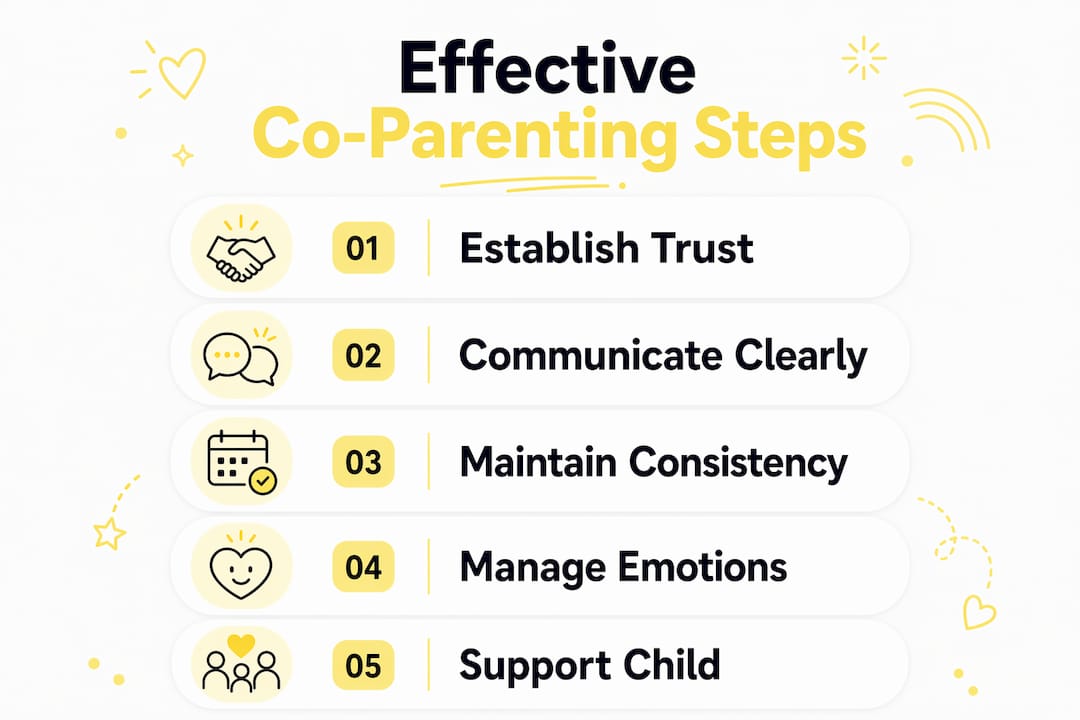
Successful co-parenting after separation requires functional cooperation, clear written communication, and consistent routines, not emotional harmony between former partners.
| Point | Details |
|---|---|
| Use the BIFF method | Keep messages brief, informative, friendly, and firm to reduce conflict at the source. |
| Write everything down | Written communication creates records, slows pace, and removes tone misreads. |
| Align on core routines | Consistent bedtimes and discipline basics across homes reduce child anxiety during transitions. |
| Parallel parenting is valid | High-conflict situations call for minimal interaction, not forced cooperation. |
| Document child behavior | Dated, objective records protect your child's interests without requiring blame. |
What I've learned about treating co-parenting like a job
Most parents enter co-parenting after separation hoping it will eventually feel natural. In my experience watching families work through this, the ones who struggle longest are the ones waiting for the emotional relationship to heal before they can function as co-parents. That wait is indefinite.
The shift that actually works is treating co-parenting like a professional partnership. You do not need to like your business partner. You need to show up, communicate clearly, and keep the shared project, your child, on track. That reframe sounds cold, but it is genuinely liberating. It removes the expectation that every exchange needs to feel good.
The other pattern I see consistently: parents who invest in their own emotional regulation get better results faster than parents who focus on changing the other parent's behavior. You cannot fix an uncooperative co-parent. You can become someone who does not escalate, does not retaliate, and does not bring the adult conflict into the child's space. That consistency, over months and years, is what children remember.
Perfect co-parenting is not the standard. Functional cooperation is. If your child moves between two homes without dreading it, that is a success worth protecting.
— Sam
How Meetkindred supports your co-parenting journey

Co-parenting is hard enough without trying to figure it out alone at 11 p.m. when you need a calm, clear response to a difficult message. Meetkindred is an AI parenting coach built for exactly these moments. The app's shared co-parent mode keeps both parents aligned on schedules, milestones, and routines without requiring direct negotiation for every detail. You can practice tough conversations before they happen, track your child's patterns, and get real strategies grounded in child development, not generic advice. If you are working to build better co-parenting habits, Meetkindred gives you a structured, private space to do it.
FAQ
What does it mean to co-parent effectively after separation?
Effective co-parenting after separation means functional cooperation focused on the child's best interest, not emotional closeness between former partners. It requires clear communication, consistent routines, and the ability to separate adult conflict from parenting decisions.
What is the BIFF method for co-parenting communication?
The BIFF method stands for Brief, Informative, Friendly, and Firm. Messages should be two to five sentences, focused on logistics, and free of emotional language to reduce conflict and misinterpretation.
What is parallel parenting and when should I use it?
Parallel parenting is a strategy where both parents fulfill their responsibilities with minimal direct interaction. It is the recommended approach for high-conflict situations where standard co-parenting communication consistently escalates.
How do I document co-parenting issues without it becoming a blame game?
Keep a child behavior log with specific dates, observable behaviors, and any professional observations from teachers or doctors. Objective, dated records inform therapists and courts without requiring you to characterize the other parent's motives.
How can I co-parent peacefully when my ex is hostile?
Switch to written-only communication, keep every message strictly logistical, and consider involving a mediator or parenting coordinator. Focusing on your own consistency and integrity, rather than the other parent's behavior, produces better outcomes for your child over time.