
Real-time parenting coaching is defined as live, personalized guidance delivered to parents during or immediately after child-rearing challenges, giving them the tools to respond effectively in the moment. The benefits of real-time parenting coaching go far beyond convenience. Research from 2026 confirms that telehealth-based programs like those offered through Meetkindred produce improved parenting behaviors at two months post-intervention, including reduced hostility and increased positive reinforcement. Unlike parenting books or weekly therapy sessions, real-time support meets you where the problem actually lives: in the middle of a meltdown, a power struggle, or a moment when you genuinely do not know what to do next.
1. Benefits of real-time parenting coaching on skills and behavior

The most direct advantage of live parenting coaching is measurable improvement in how you parent, not just how you think about parenting. Studies show that parents who receive real-time feedback during interactions with their children demonstrate reduced intrusiveness and greater sensitivity, two behaviors that directly shape a child's emotional security and cooperation. This is not a subtle shift. Coded video analysis of 201 families found these changes were statistically significant after intervention.
Real-time coaching improves specific skills that generic parenting advice rarely touches. Behavior management, communication tone, and the timing of praise all shift when a coach can observe and respond to what is actually happening between you and your child. Parents in telehealth trials reported lower hostility scores and higher rates of positive reinforcement after just a few sessions.
- Behavior management: Coaches help you identify triggers and redirect behavior before escalation.
- Communication: You learn to phrase instructions in ways children respond to, not just comply with.
- Positive reinforcement: Real-time feedback trains you to catch good behavior in the moment, which is the most effective time to reinforce it.
- Emotional regulation: Coaches model calm responses during high-stress interactions, giving you a script you can internalize.
Pro Tip: Ask your coach to observe a real interaction with your child, not just discuss it afterward. Live observation produces faster skill transfer than retrospective conversation.
2. Accessibility and convenience of telehealth parenting coaching
Telehealth delivery removes the two biggest barriers to parenting support: transportation and scheduling. Parents in rural or underserved communities who previously had no access to trained parenting coaches can now connect via smartphone or tablet. This matters because the families who need coaching most are often the ones least able to reach it.
"Virtual parenting programs produce child behavior improvements comparable to in-person delivery, especially with structured skills training and caregiver support." — Meta-analytic evidence from 15 randomized trials
The data on telehealth versus in-person coaching is more reassuring than most parents expect. Here is how the two delivery formats compare across key dimensions:
| Factor | In-person coaching | Telehealth coaching |
|---|---|---|
| Child behavior outcomes | Strong improvements | Comparable improvements |
| Parental sensitivity gains | Slightly stronger | Significant, slightly lower |
| Intrusiveness reduction | Significant | Significant |
| Access for rural families | Limited | Broad |
| Session flexibility | Fixed schedule | On-demand or scheduled |
| Moment-to-moment feedback | High | High (via live video) |
Telehealth coaches can deliver frequent, high-quality feedback during parent-child interactions in real time, preserving the core mechanisms that drive behavior change. The absence of physical presence does not eliminate coaching quality. It does eliminate the commute, the childcare logistics, and the waiting room.
3. How personalized feedback transforms skill implementation
Generic parenting advice fails at the implementation stage. You can read that "consistency is key" a hundred times and still not know what to do when your four-year-old refuses to put on shoes at 7:45 a.m. Real-time personalized feedback closes that gap by turning abstract principles into precise responses for your specific child.
The mechanism that makes this work is the active discussion component. Research on the Triple P telehealth program found that active discussion during sessions produced better parenting behavior improvements than seminar-only formats. When you can ask a question mid-session and get an answer calibrated to your child's age, temperament, and history, skill transfer accelerates.
Here is how the feedback loop works in practice:
- Observation: The coach watches a live or recorded interaction between you and your child.
- Identification: The coach pinpoints the exact moment where a different response would change the outcome.
- Instruction: You receive a specific, worded alternative to try immediately.
- Practice: You apply the strategy in real time or in a role-play scenario.
- Refinement: The coach adjusts based on what you actually did, not what you intended to do.
Remote parent coaching has been shown to improve parent-infant joint attention and verbal responsiveness with effects maintained over time. The feedback loop is what makes those gains stick.
Pro Tip: Before each coaching session, write down one specific moment from the past week where you felt stuck. Concrete examples give your coach the raw material to deliver feedback that actually applies to your life.
4. Long-term outcomes and evidence-based results
The benefits of parenting guidance do not evaporate after the program ends. Internet-based parent management training, which shares the structured skills approach of real-time coaching, produced parenting and behavior improvements with small-to-medium effects lasting at least two months after the program concluded. That durability matters because it means you are building a skill set, not just getting through a crisis.
The data on brief interventions is particularly striking. A single-session telehealth intervention produced large effect sizes across parental agency, stress reduction, and child behavior at a two-week follow-up. This tells you something important: you do not need months of weekly sessions to see real change. Targeted, real-time support at the right moment can shift family dynamics faster than traditional weekly therapy.
| Outcome measured | Evidence level | Time frame |
|---|---|---|
| Reduced child behavioral problems | Randomized trial, 15 studies | 2 months post-intervention |
| Improved parental sensitivity | Coded video, 201 families | Post-intervention |
| Reduced parental stress | Open clinical trial, N=17 | 2-week follow-up |
| Increased parental agency | Large effect sizes | 2-week follow-up |
| Sustained behavior improvements | Internet-based RCT, 250 completers | 2 months post-program |
One nuance worth knowing: parental confidence may not change immediately even when behavior and knowledge improve measurably. This is normal. Confidence follows competence, and competence builds through repeated practice with feedback. Do not measure your progress by how confident you feel after session one.
5. When real-time parenting support matters most
Real-time parenting support is not a replacement for every form of parenting help. It is the right tool for specific situations where immediate, personalized guidance produces outcomes that books, podcasts, or parenting classes cannot match.
- High-stress periods: A single-session telehealth intervention improved parental readiness and reduced stress with large effect sizes, making it especially useful during acute family stress.
- Intense or persistent child behavior: When a child's behavior is escalating and standard strategies are not working, real-time coaching gives you a trained observer who can spot what you are missing.
- Early developmental concerns: Parents of infants and toddlers benefit from coaching during the window when communication and attachment patterns are forming.
- Co-parenting misalignment: When two caregivers are responding to a child inconsistently, a shared coaching session can align strategies faster than separate reading or advice.
- Transition periods: School starts, new siblings, moves, and divorce all create behavioral disruption. Real-time coaching during these windows prevents small problems from becoming entrenched patterns.
Traditional parenting classes deliver information. Real-time coaching delivers application. The strongest evidence for remote coaching comes from structured, evidence-based programs that combine skills training with active caregiver support. When you are choosing a program, look for those two elements together, not one without the other.
Key takeaways
Real-time parenting coaching works because it delivers personalized, live feedback during the exact moments when parents need it most, producing measurable improvements in child behavior, parental sensitivity, and family stress that last beyond the program itself.
| Point | Details |
|---|---|
| Live feedback accelerates skill transfer | Active discussion during sessions produces faster behavior change than seminar-only formats. |
| Telehealth matches in-person outcomes | Virtual delivery produces comparable child behavior improvements across 15 randomized trials. |
| Brief interventions produce real results | A single telehealth session improved parental agency and stress with large effect sizes at two weeks. |
| Confidence lags behind competence | Behavioral improvements appear before parents feel confident; track skills, not feelings. |
| Structured programs outperform advice alone | Evidence-based programs with skills training and caregiver support drive the strongest outcomes. |
What I have learned from watching real-time coaching work
I have spent years watching parents receive advice that sounds right in a seminar and falls apart at 6 p.m. on a Tuesday. The gap between knowing what to do and doing it under pressure is where most parenting support fails. Real-time coaching is the only format I have seen consistently close that gap.
The parents who get the most out of live coaching are not the ones in the deepest crisis. They are the ones who show up with a specific problem and stay curious about the feedback. A coach watching you interact with your child will notice things you cannot see from inside the interaction. That outside perspective, delivered in the moment, is genuinely irreplaceable.
One thing I would push back on: the assumption that telehealth coaching is a lesser substitute for in-person work. The research does not support that assumption. What matters is whether the program includes live observation, active discussion, and individualized feedback. A telehealth session with those three elements outperforms an in-person seminar without them every time.
If you are choosing a coaching program, prioritize structure over format. Look for programs built on evidence-based frameworks like Triple P or ABC, delivered by coaches who observe real interactions and give you specific, worded responses to try. Avoid programs that give you a list of tips and call it coaching. Tips are not coaching. Feedback is coaching.
— Sam
Meetkindred gives you a real-time parenting coach, 24/7
Parents do not have crises on a schedule. Meetkindred is built around that reality.
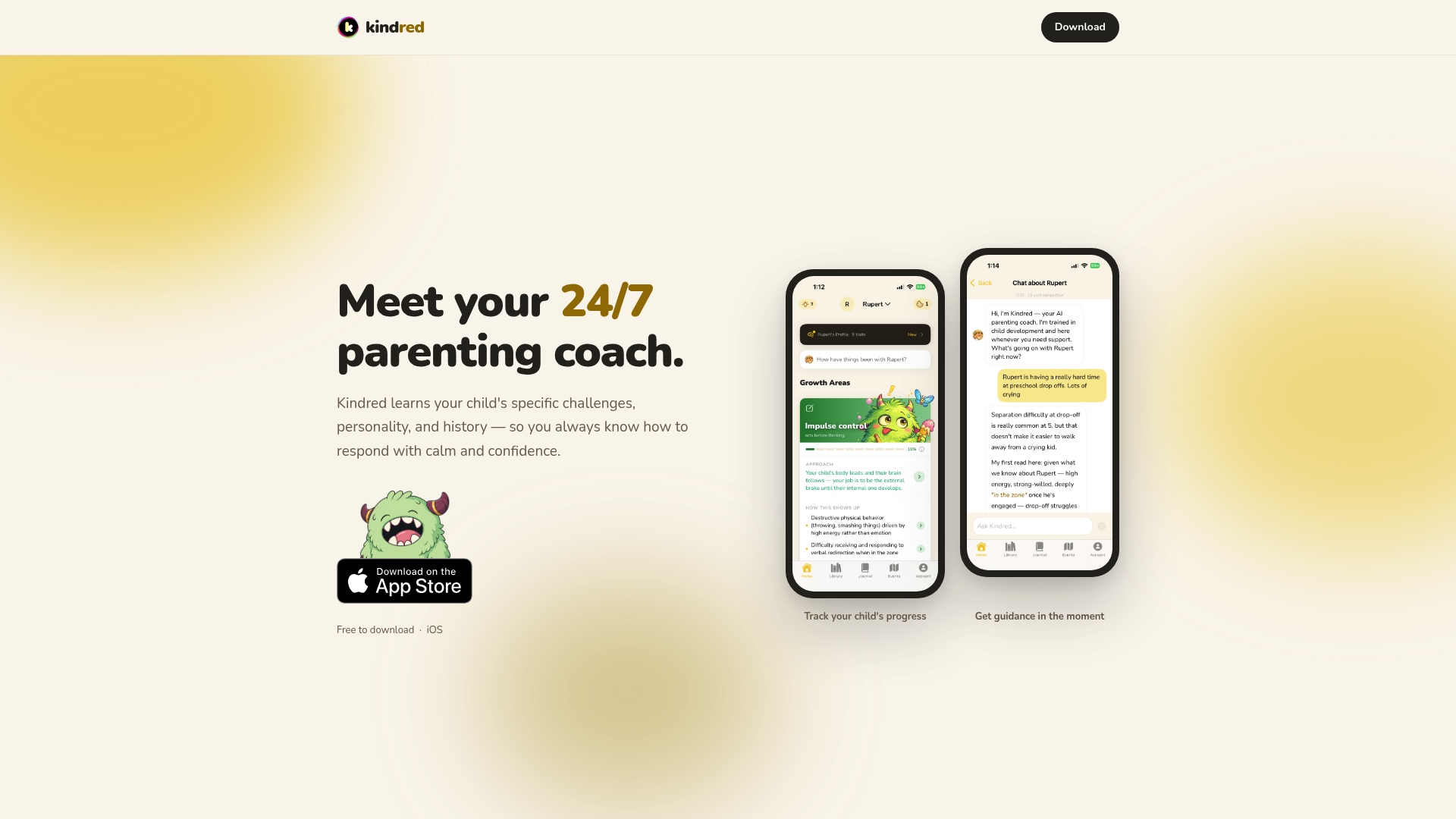
Meetkindred is an AI parenting coach trained in child development that learns your child's unique patterns and delivers strategies specific to your family, not generic advice that could apply to anyone. You can chat with your coach at any hour, practice tough scenarios before they happen, and track your child's milestones over time. The shared co-parent mode keeps both caregivers aligned on the same strategies, which research confirms is one of the most effective ways to reduce child behavioral problems. If you are ready to move from advice to application, start with Meetkindred and get real-time support built around your child.
FAQ
What is real-time parenting coaching?
Real-time parenting coaching is live, personalized guidance delivered by a trained coach during or immediately after parent-child interactions. It differs from parenting classes by providing individualized feedback on your specific behavior rather than general information.
How effective is telehealth parenting coaching compared to in-person?
Research across 15 randomized trials shows virtual parenting programs produce child behavior improvements comparable to in-person delivery, particularly when programs include structured skills training and active caregiver support.
How quickly can parenting coaching produce results?
A single-session telehealth intervention produced large effect sizes in parental agency, stress reduction, and child behavior at a two-week follow-up, showing that targeted real-time support can shift outcomes faster than extended traditional therapy.
Will my confidence improve right away with coaching?
Parental confidence may not change immediately even when behavior and knowledge improve measurably. Competence builds through repeated practice with feedback, and confidence typically follows several weeks later.
When should I choose real-time coaching over a parenting class?
Choose real-time coaching when you need personalized feedback on a specific behavior, during high-stress family periods, or when your child's behavior is escalating and general strategies are not producing results.